

 5 Jul
5 JulCat Furniture Guide: How to Create Vertical Spaces Your Cat Will Actually Use
If you’ve ever bought a cat tree that ended up as an expensive dust collector while your cat perches proudly on top of the fridge, you’re not alone. Most vertical cat furniture fails not because cats don’t want height — they desperately do — but because the furniture doesn’t match how cats actually think about space. Here’s how to get it right.
Why Cats Need Vertical Space (Instinct, Not Preference)
Cats aren’t just being quirky when they scale your bookshelf or claim the top of the closet. In the wild, height means safety and control. An elevated cat can see danger coming, avoid confrontation with other animals, and survey territory without expending energy. This instinct doesn’t disappear indoors — it just gets redirected toward your furniture, counters, and curtain rods.
Vertical space also gives indoor cats something horizontal square footage can’t: a sense of territory expansion. A 600-square-foot apartment can effectively double its usable “cat space” once you factor in walls, shelves, and elevated walkways. This matters especially in multi-cat households, where height lets cats avoid each other without a real confrontation — a shy cat can watch from a shelf while a more confident cat has the floor.
Height also reduces stress. Studies on shelter cats have repeatedly shown that cats with access to elevated hiding spots show lower cortisol markers and recover from stressful events faster than cats confined to floor level. So when your cat bolts for the top of the tree during a thunderstorm or a visitor’s arrival, that’s not random — it’s a coping mechanism doing exactly what it evolved to do.
The Mistake Most Owners Make (Buying Too Small)
The single biggest reason cat trees go unused is that they’re sized for the room, not the cat. A 32-inch tree looks proportional in a store aisle, but to a cat, it barely qualifies as “up.” Cats want real height — enough to look down on the room from a genuinely elevated vantage point, ideally 5–6 feet or more.
The second mistake is stability. Cats will not commit to jumping onto a wobbly platform, especially bigger cats or older ones who’ve had a bad experience with a tipping tree. If a tree sways when you nudge it, your cat has already decided it’s not trustworthy — no amount of catnip spray will fix that.
The third mistake is buying one piece of furniture and expecting it to satisfy every instinct. Cats want a system: a place to scratch, a place to perch, and a place to hide, ideally not all crammed into the same tower. A single generic tree in the corner of the living room checks none of these boxes particularly well.
Where to Place Cat Furniture for Maximum Use
Placement determines whether furniture gets used far more than the furniture itself does. A general rule: cats want vertical space near the action, not tucked away in an unused corner.
- Near windows. A shelf or perch facing a window is almost always adopted immediately — birds, cars, and weather are prime entertainment.
- Adjacent to where the household gathers. Cats want to observe, not be isolated. A tree in a rarely-used guest room will sit empty; the same tree near the living room sofa gets used daily.
- Along natural travel routes. Cats like to patrol. Wall shelves that create a path from one side of a room to another — or that connect to a windowsill or cat door — tend to get used as a circuit, not just a destination.
- Away from loud appliances. Furniture near the washing machine, HVAC vents, or a busy front door often gets avoided, even if the height and location otherwise make sense.
- In multi-cat homes, spread it out. Multiple elevated spots in different rooms reduce competition and let more timid cats access height without a standoff.
Scratcher vs Cat Tree vs Wall Shelf
Each type of furniture solves a different problem, and most homes benefit from a mix rather than one all-in-one solution.
Scratchers are about claw maintenance and marking territory, not height. Vertical scratching posts should be tall enough for a cat to fully extend upward — often taller than owners expect — and sturdy enough not to tip during an enthusiastic scratch session. Horizontal scratchers suit cats that prefer to scratch at floor level and are a good complementary option rather than a replacement.
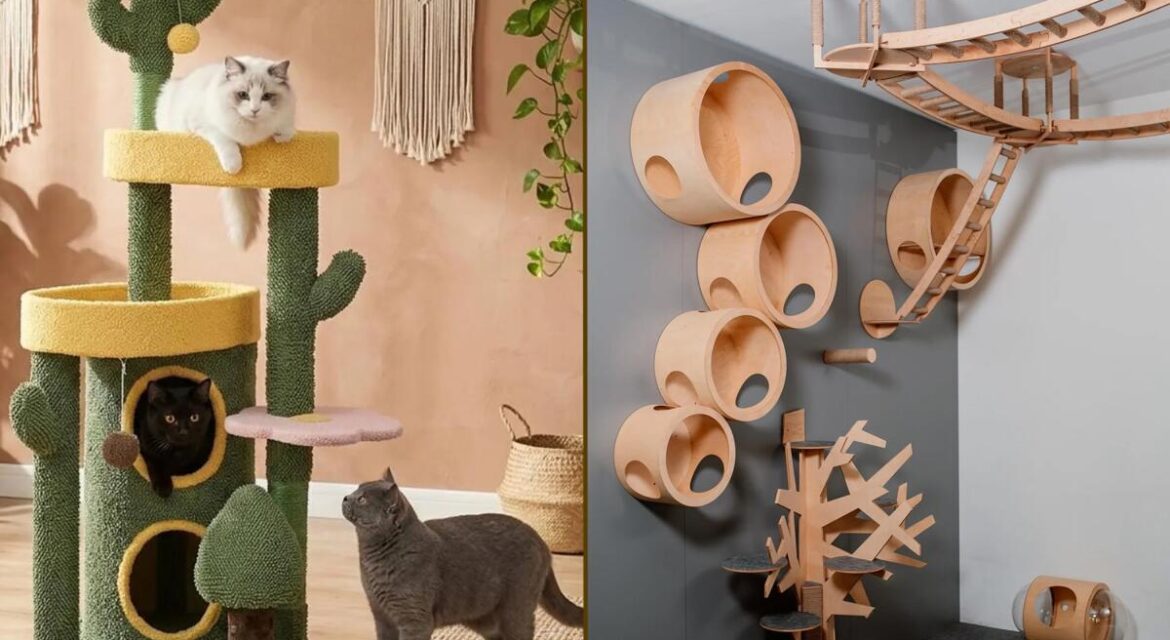
Cat trees combine scratching, perching, and hiding in one piece of furniture, which makes them a strong all-around option, especially for cats without much other vertical access. The tradeoff is footprint — a tree tall and stable enough to be worthwhile takes up real floor space, and lower-quality trees often fail the stability test above.
Wall-mounted shelves are the best option for maximizing usable vertical space without sacrificing floor space, and they let you build multi-level “cat highways” that a standalone tree can’t replicate. The tradeoff is installation — shelves need secure mounting into studs, and cats will test every shelf’s stability before trusting it, so half-measures with weak anchors tend to backfire.
Most cats benefit from having at least one of each: a scratcher for claws, a tree for a home base with hiding options, and shelves for exploration and window access.
How to Introduce New Furniture to a Reluctant Cat
New furniture is often ignored for the first few days — that’s normal, not a sign of failure. Cats approach new objects cautiously, and rushing the process usually backfires.
- Don’t place your cat on it. Let them investigate at their own pace. Being physically placed somewhere new often creates a negative association instead of curiosity.
- Use scent and treats strategically. Rubbing a bit of catnip on scratching surfaces, or placing treats on progressively higher levels of a tree, encourages a cat to explore upward gradually.
- Keep existing favorite spots available. Don’t remove an old scratching post or perch the same week you introduce a new one — let the cat compare and choose rather than forcing a transition.
- Give it time near existing routines. Furniture placed somewhere the cat already walks past daily gets discovered naturally, faster than furniture stuck in an unfamiliar room.
- Reward, don’t push. If your cat does climb or scratch on the new furniture, calm praise or a treat reinforces the behavior. Pressure or excessive attention can have the opposite effect on a nervous cat.
Most cats fully adopt new vertical furniture within one to two weeks, especially once it’s positioned somewhere central and stable.